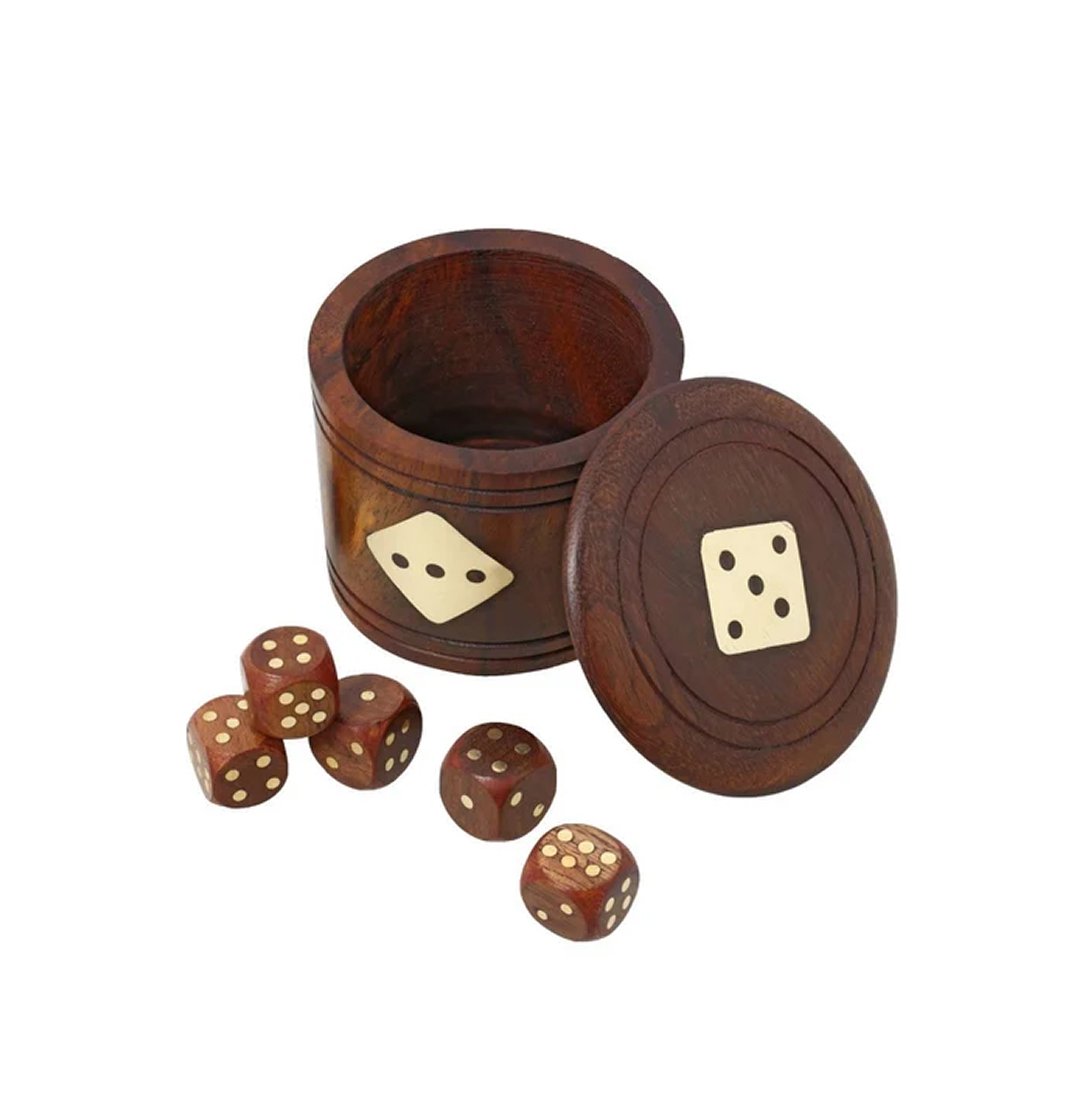
Brass inlay is among the oldest decorative traditions in Indian woodworking. The technique — cutting recesses into wood and filling them with metal — has been practised in Saharanpur and the surrounding craft belt of Uttar Pradesh for at least three centuries. At our workshop in Nagina, Bijnor, it remains entirely a hand process.
Why brass
Brass is an alloy of copper and zinc. It is softer than steel, which makes it easier to work, but hard enough to hold fine detail. Its warm yellow tone contrasts beautifully against the dark browns of Sheesham and Acacia. Over time, brass develops a patina — it darkens slightly and loses its initial shine — which actually looks better on wooden objects than the bright original finish.
The process
Design transfer: The design — a paw print, the word POKER, corner accents, a geometric pattern — is transferred to the wood surface using carbon paper or a sharp scribe. Precision here determines everything that follows.
Routing: Recesses are cut to a depth of approximately 1–1.5mm using small chisels and, for larger areas, a router. The walls of the recess must be clean and vertical for the inlay to sit flush. Our most experienced artisans can cut recesses with a chisel that need almost no cleaning up before inlay.
Cutting the brass: Sheet brass is cut to match the routed recess using jeweller's shears for straight lines and a fret saw for curves. Small details — like individual letters — are cut from pre-made brass stock, then refined by hand filing.
Setting: The brass piece is pressed into the recess. A correctly sized inlay should require firm thumb pressure to seat. If it drops in freely, it is too loose; if it cannot be seated without deforming, it is too large. Each piece is checked and adjusted before being set with epoxy.
Levelling: After the epoxy cures (overnight, minimum), the surface is scraped with a cabinet scraper to bring the brass flush with the wood. This is the most tedious part of the process. Any brass proud of the surface will catch the light and look unfinished. Any brass below the surface leaves a visible shadow at the joint.
Finishing: The completed piece is sanded from 120 through 320 grit, then oiled. The oil slightly darkens the wood, making the brass contrast more vivid.
What can go wrong
Inlay is unforgiving. If the recess is even 0.2mm too deep on one side, the inlay will rock. If the brass is cut even marginally too small, there will be a visible gap at the joint. This is why inlay work takes years to master and why it cannot be automated without losing the quality that makes it worthwhile.
Every Crafteve piece with brass inlay is inspected under a loupe before dispatch. We reject pieces that have visible gaps, proud brass, or inconsistent levelling. This is not perfectionism for its own sake — it is respect for the customer who will live with this object for decades.
See brass inlay in our collection
The Brass-Inlay Dice Box, Acacia Poker Box, and Tic-Tac-Toe set all feature this hand-inlay technique. Every piece is inspected under a loupe before dispatch.
Browse Chess & Games